Livestock of the Sun
In old Lappish folklore, reindeer are called the livestock of the Sun. The Sun gave reindeer to people so that they would not have to perish in the fruitless emptiness of the mountains. Jubmel created the lands from a reindeer calf. The rocks were formed from its bones, the land and soil from its muscles, but the calf’s heart was hidden deep within the earth. While walking in the wind, a lonely traveler can sometimes hear the heartbeat of the reindeer calf.
Throughout the entire history of human life in the Arctic, the reindeer has been an essential companion to people. It’s no wonder, then, that reindeer remain deeply woven into the fabric of Lapland’s culture even today.
Although traditional folklore has gradually given way to scientific understanding, even modern research helps us see why the reindeer was once viewed as a divine, almost magical creature. With its extraordinary biological adaptations, the reindeer is quite literally a true superhero of the Arctic.
Reindeer (Rangifer tarandus tarandus) – A True Arctic Survivor
The reindeer is a semi-domesticated animal native to the Arctic regions. Adult males stand about 110 cm tall at the shoulder and can weigh up to 200 kg. Females are slightly smaller, standing around 100 cm tall and weighing up to 100 kg.
Reindeer are long-legged, four-toed herbivores that have adapted remarkably well to the harsh, cold, and snowy Arctic environment. Their hooves are shaped like half-circles, which helps distribute their weight more evenly on snow. Thanks to this unique design, the pressure they exert on the snow surface is very low — a useful adaptation in winter conditions.
Still, moving through deep, soft snow is hard work, even for reindeer. Whenever possible, they prefer to avoid such terrain to conserve energy.
The Role of Antlers in Herd Dynamics
Both male and female reindeer grow solid bone antlers that fall off and regrow each year. In fact, reindeer are the only deer species where females also grow antlers.
Adult males typically shed their antlers after the rutting season in November, while females keep theirs through the winter and shed them after calving in May. Young males (1 to 3 years old) also keep their antlers until March-April. Castrated males shed theirs usually somewhere between December and March. This means that Santa’s reindeer are castrated males.
Reindeer antlers are the fastest-growing bone tissue in the animal kingdom — in summer, they can grow up to two centimeters per day. In that sense, a reindeer truly is a living bone factory.
Antlers play an important role in the social life of the herd. They signal status: when a reindeer loses its antlers, its rank in the herd weakens. Males use their antlers in fights during the rutting season, while females often use theirs to protect feeding spots in winter.
Even calves begin growing their first antlers during their first summer. By October, their antlers can be surprisingly long. Sometimes calves’ antlers may even have small branches, but they are often simple and unbranched in shape.
You can’t determine a reindeer’s exact age by its antlers, but there are some patterns. Younger animals tend to have smaller antlers until about the age of four or five, after which they reach their peak size. Around age ten, antlers usually begin to shrink a bit again.
The Many Colours of Reindeer
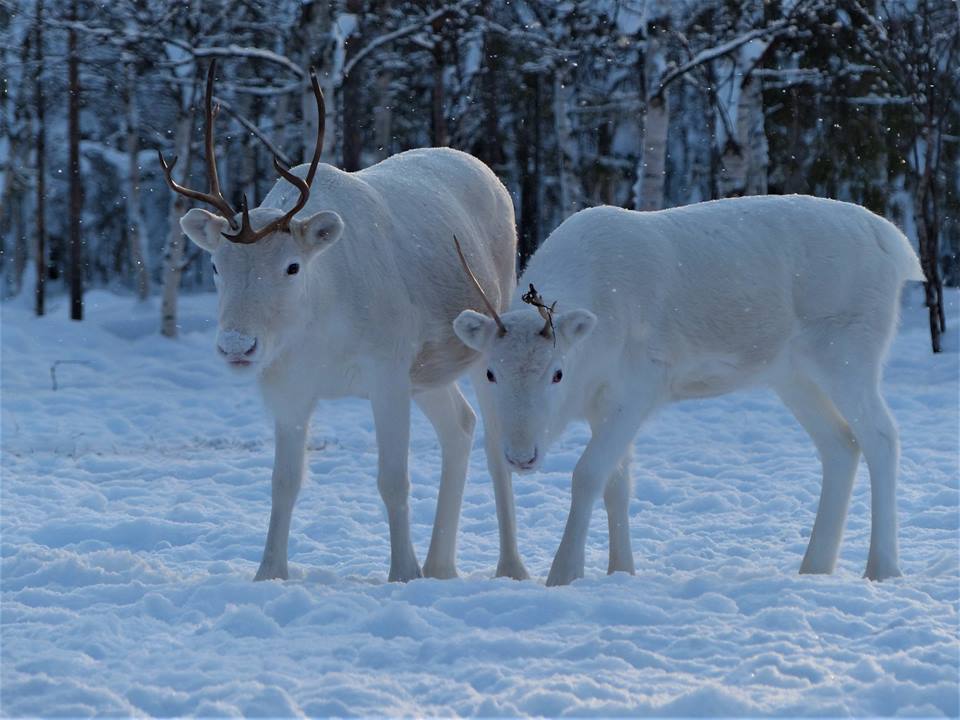
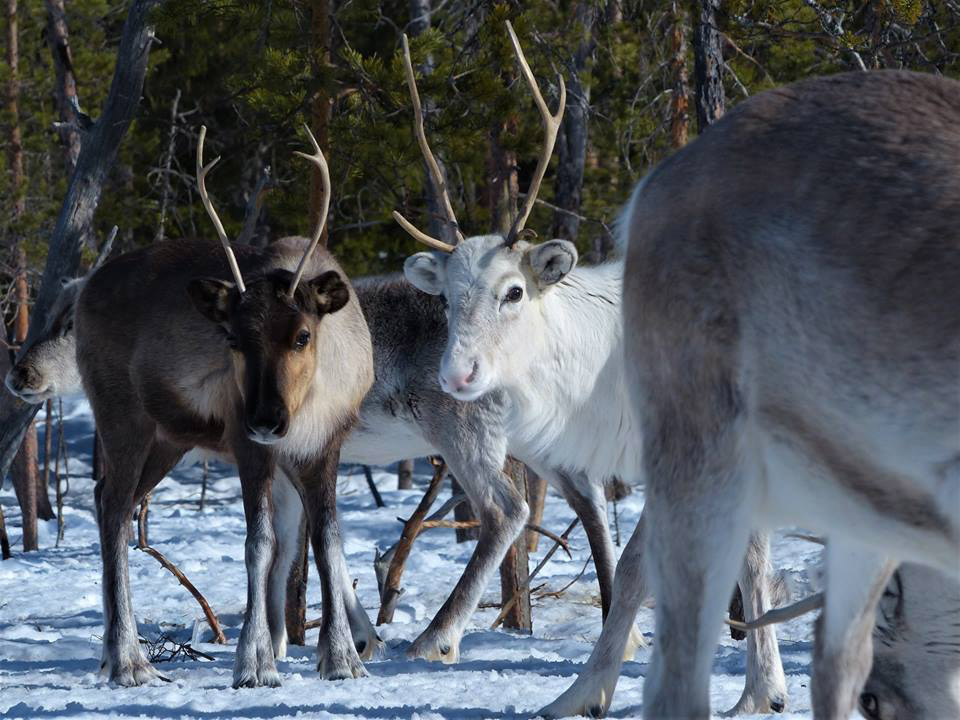
Reindeer come in a wide range of colours, from nearly black to various shades of grey, as well as some brownish or beige tones — all the way to pure white. In reindeer herders’ vocabulary, there are dozens of specific names for these different colour variations.
Reindeer may also have distinctive white or black markings on their head, legs, or elsewhere on the body, adding even more variety to their appearance.
For example, a dark-coloured reindeer is called a musikki, a light one is a suivakko, and a white one is a valkko. Despite all these poetic terms, the most common colour doesn’t have a particularly imaginative name — it’s simply called “reindeer-coloured.”
Reindeer can adjust to changing temperatures
A reindeer’s body stays warm under its thick fur, but its legs and feet are more exposed to the cold Arctic air. Still, reindeer manage to keep their feet from freezing thanks to two key adaptations: efficient blood circulation and the presence of oleic acid in the bone marrow.
The blood vessels in the legs are arranged in a special vein-artery system that helps retain warmth. Warm arterial blood flowing to the feet runs alongside cooler venous blood returning to the heart, allowing heat to transfer between them. This system helps conserve body heat and reduces heat loss in cold environments.
When the temperature drops below freezing, the surface temperature of a reindeer’s feet can be just a few degrees above zero. To cope with this, oleic acid in the bone marrow acts like a natural antifreeze, especially in the lower parts of the legs, helping to prevent freezing even in extreme cold.
Reindeer are remarkably well adapted to extreme temperature changes. The difference between summer and winter temperatures in the Arctic can be as much as 90 degrees Celsius. To cope with this, reindeer shed their dense winter coat in summer, and a new layer of fur begins to grow again in August.
Their fur is specially designed for insulation. The hairs are thick and contain air pockets that trap heat. An adult reindeer can have up to 1,700 hairs per square centimeter, and the fur can be about 4 cm thick. For every outer guard hair, there are several fine underhairs that block airflow and prevent heat loss. These air pockets also make the fur light, yet extremely warm — allowing reindeer to survive in temperatures as low as -60°C.
Thanks to its excellent insulation properties, reindeer hide is traditionally used as a warm sleeping pad. It resists moisture well and provides reliable warmth even in the harshest winter conditions.
Smell and sight
The most important sense for a reindeer is smell. Reindeer can detect the scent of lichen and other food sources through thick layers of snow. They don’t begin digging unless they smell something underneath — an important energy-saving strategy for surviving the long, harsh winter.
When reindeer flee from danger, they lift their tails to reveal the white underside. This acts as a visual cue for others to follow, helping the herd stay together as they run.
Reindeer eyes change color with the seasons
Reindeer eyes are also uniquely adapted to extreme seasonal changes in light. To cope with months of Arctic winter darkness and continuous summer sunlight, a reindeer’s eyes change colour between seasons — enhancing their vision in low light and helping them survive in one of the most challenging environments on Earth.
Scientists from UCL and the University of Tromsø discovered that reindeer can change the colour of the tapetum lucidum, a reflective layer in the eye that enhances night vision. In summer, this layer is golden, like in most mammals. But in winter, when darkness lasts for weeks, it turns deep blue — increasing the eye’s sensitivity to low light by scattering more light to the retina.
This is the first known case of such a seasonal colour change in mammals. Researchers believe it may help reindeer survive by improving their ability to spot predators in near-total darkness.
In addition, reindeer can see ultraviolet (UV) light. This ability helps them spot important food sources against the snow and detect predators such as wolves more easily in the snowy Arctic environment.